
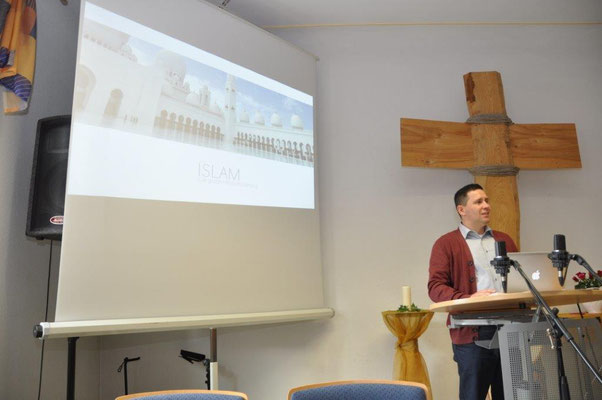

Three talks in Ladenburg connected questions of truth, God’s being, and the gospel. The aim was to strengthen Christians for conversation with Muslims and explain the good news of Jesus understandably.
Looking back · October 22–23, 2016
A clear Christian conviction needs a fair presentation of the conversation partner. We want to name differences openly while treating people with the respect due them as God’s creatures.
‘What is truth?’
On the weekend of October 22–23, 2016, I was invited to give three talks at a church in Ladenburg. With the young people in the morning, we considered ‘What is truth?’ The focus was the foundation for people’s ability to recognize truth and trust their convictions with good reason.
The Christian view connects this possibility with the truthful Creator and humanity as his image. We are limited but capable of real knowledge. For us, God’s revelation is therefore no competitor to thought, but orientation for our thinking.
The question of ultimate foundations must not, however, be confused with the claim that a person must be omniscient to know anything at all. Limited knowledge can be real knowledge. What needs clarification is how its reliability is justified and how we recognize our errors.
Explain the Trinity understandably
Saturday afternoon concerned the biblical confession of Father, Son, and Holy Spirit. We considered Jesus’ deity and objections to it. An important starting point is distinguishing actual Christian doctrine from ideas Christians themselves reject.
Christians do not confess three gods. They confess one God in three persons. Mary does not belong to the Trinity. Nor does Jesus’ sonship mean God physically begetting a child with a woman. Clearing up these misunderstandings first establishes a foundation for objective conversation about the actual differences.
Remain precise in source work
Surah 5:116 addresses worship of Jesus and Mary alongside God. It does not, however, explicitly define the Trinity as ‘God, Mary, and Jesus’. Whether and how the verse targets Christian doctrine or religious practice requires separate investigation. Surah 3:54 likewise describes God’s counterplan to opposing plans; this does not straightforwardly imply the general claim that Islam teaches a fundamentally unreliable revealer.
Such refinements do not weaken the Christian position. They help us actually examine what the other text claims. Those expecting Muslims to present the gospel accurately should apply the same standard themselves.
The gospel for Muslims
Sunday focused on the saving message of Jesus Christ. The decisive question is not whether we can impress God with an adequate performance record. It concerns what God has done in Christ for guilty people.
Romans 3:21–26 connects God’s righteousness with redemption in Christ. Ephesians 2:8–10 distinguishes the gift of salvation from the good works to which believers are called. Works are the task of saved life, not its purchase price. Those trusting Christ may ground assurance in the Savior and his promise.
Islam too speaks of God’s mercy. The blanket contrast ‘Muslims know only performance, Christians alone mercy’ would therefore be too crude. The actual difference must be stated more concretely: Who is Jesus, what does his cross mean, and what grounds assurance of forgiveness? Here lies the heart of Christian witness.
We want to do more than explain which views we oppose. We want to show why Jesus Christ is a sufficient and trustworthy Savior.
This perspective holds apologetics and evangelism together. Good arguments can clear away misunderstandings. Their goal is an understandable witness to Christ, sustained by patience and love toward those with whom we speak.
For deeper study
Romans 3:21–26; Ephesians 2:8–10; John 5:24; 1 Peter 3:15–16. Islamic primary texts: Surah 5:116 and Surah 3:54. The report preserves the occasion and subjects of the 2016 weekend; the explanatory sections provide precise theological context.